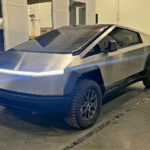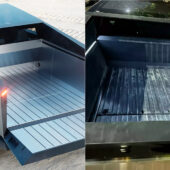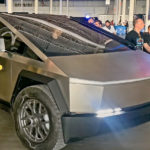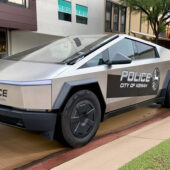
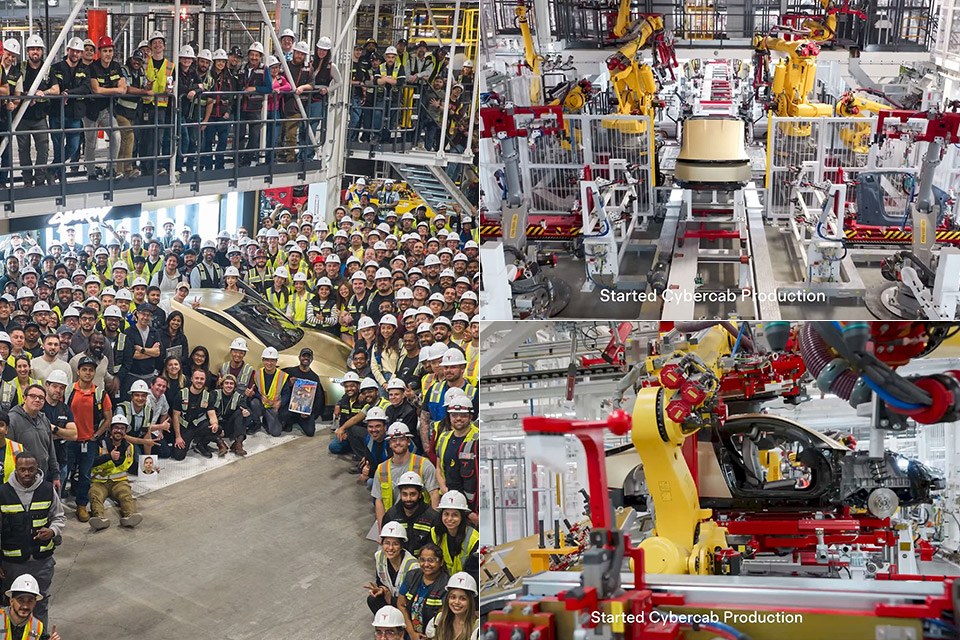
Employees gathered around the first production Cybercab for a photo taken by Tesla, and Elon Musk quickly responded with his own thoughts on the historic occasion. Yes, this Cybercab came out of Giga Texas roughly 6 weeks ahead of schedule, with larger production plans set to begin in April.
It’s game over for all ride hailing companies pic.twitter.com/5vFPtmTsLY
— Teslaconomics (@Teslaconomics) February 17, 2026
This Cybercab is unlike anything Tesla has previously built, with a compact cabin and two seats arranged in a traditional forward-facing, side-by-side format. No steering wheel or pedals. It’s based primarily on one concept: full self-driving. The lack of manual controls makes perfect sense considering that Tesla’s system is designed to function that way. Inductive charging eliminates the need for a plug.
No products found.
Giga Texas has a new production line deidcated to this car. The “Unboxed” process is well-known to Tesla, having been perfected in recent years. The key to this method is to disassemble the car into primary pieces, which can then be assembled in distinct zones all at once. Large sections of the automobile are cast in a single piece, and the teams put it all together in the final phases. This parallel approach, as opposed to the traditional assembly line, requires less space, reduces production time, and decreases costs.
Musk has already stated that the production will be sluggish in the beginning before increasing in the usual S-curve pattern that Elon has observed on other ramps. Production is set to begin at scale in April, and they can already produce a lot more vehicles if the small issues are worked out. Annual capacity could eventually approach tens of millions of units, while several variables remain to be calibrated, including the new design, suppliers, and autonomy hardware testing.
As things stand, this is a significant milestone for Tesla. They already have some robotaxi operations up and running, even though they’re still in the experimental stage with modified Model Y’s in areas like Austin, but the Cybercab represents a huge step forward in executing this at scale and at reduced costs. However, regulatory difficulties remain, and in the United States, there are several government safety regulations that the Cybercab does not meet. Tesla is seeking exemptions wherever possible, as well as cooperating with state regulators. So, for example, California recently relaxed some restrictions on the operation of Tesla’s self-driving cars, possibly due to the business clarifying some of the verbiage surrounding the system.