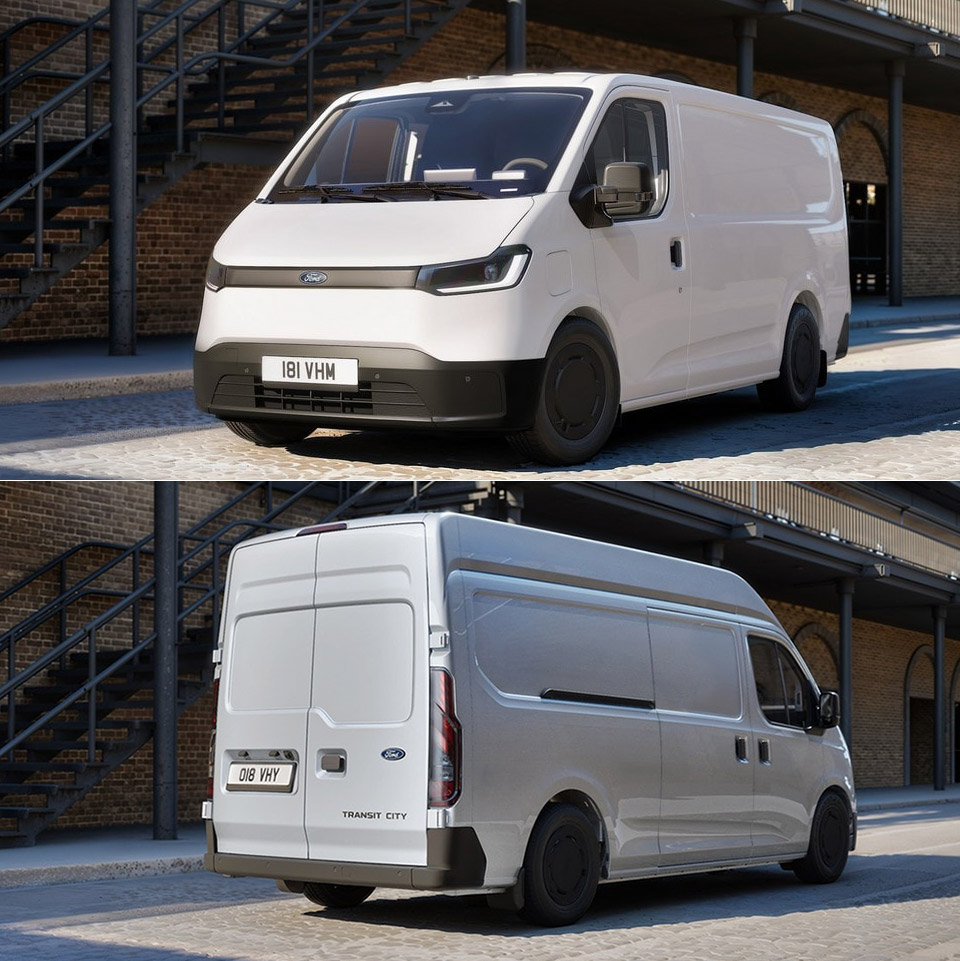
Ford has started shipping its newest electric commercial van to the UK, with the Transit City now available to configure online from £29,421 for the shorter L1H1 panel van and £31,921 for the taller L2H2 version, both excluding VAT. A £5,000 Plug-In Vehicle Grant saving applies for eligible buyers, and some customers also receive a free home charger. Built in China by Jiangling Motors, Ford’s long-time partner, the van rides on a dedicated electric platform and reaches European customers after the first 1,000 units left the Nanchang plant in late August.
To start, there are three body styles available, beginning with the smaller L1H1, which has 6.4 cubic meters of load area and a capacity of 1,085kg, or enough place for three Euro pallets. The longer, higher-roof L2H2 expands to 8.5 cubic meters, with a 3-metre load length and a payload of 1,275 kg. Later on, a chassis-cab option with payloads of up to 1,600kg will be available, basically opening the door to a wide range of bespoke van modifications through Ford’s partners, including flatbeds, tippers, and even refrigerated vehicles.

LEGO Speed Champions Ken Block's '65 Ford Mustang Hoonicorn V1 77262
- CUSTOM MUSTANG RACE CAR – This LEGO Speed Champions Ken Block's '65 Ford Mustang Hoonicorn V1 (77262) building toy for boys and girls ages 9 years old and up lets kids recreate the viral YouTube sensation's iconic custom vehicle
- AUTHENTIC DETAILS – Builders will recognize cool features from the car's debut in the 2014 Gymkhana SEVEN film, including exposed velocity stacks on the hood, custom wheels and Ken Block's number 43 logo
- KEN BLOCK MINIFIGURE – The included Ken Block minifigure features a Hoonicorn hat and jacket, plus an extra helmet accessory for added play value
$29.95

Buy on Amazon

All Transit City vehicles have a single powerplant. A 56 kWh lithium-iron-phosphate battery powers a front motor that produces 110 kw/148 horsepower and 260 Nm of torque. Under the WLTP cycle, the L1H1 can go 158 miles, whereas the L2H2 can travel 139 miles. Given that most urban delivery drivers average less than 70 miles per day, it’s pretty accurate for multi-drop routes. The acceleration from 0 to 62 mph takes 13.7 seconds, and the highest speed is limited to 75 mph. A 12-meter turning radius is ideal for city driving.

As one might imagine, the charging matches the journeys that the majority of these vans will make. DC charging peaks at 87 kW, with an average of 67 kW, ranging from 10 to 80% in 33 minutes and adds approximately 31 miles in 10 minutes. On an 11 kW AC supply, it will take approximately 4.5 hours to charge from 10% to 80%, which will work well with overnight charging at the depot. On stop-start routes, one-pedal driving is standard to reduce brake wear.

Every Transit City van has the same specifications: a 12-inch touchscreen that works with Apple CarPlay and Android Auto, as well as keyless entry, air conditioning, a heated driver’s seat, and all of the standard parking sensors, reversing camera, and adaptive cruise control. The safety package includes automated emergency braking, lane-keeping assist, and intelligent speed assist, as well as an 8-year warranty on all high-voltage components.

Orders have already started up, and the first vans will arrive in the UK before the end of 2026. More conversions and body designs will be introduced in 2027. For operators seeking to conduct city-center deliveries, grocery runs, or local trades, the Transit City is an excellent electric van that keeps things simple and prioritizes payload, maneuverability, and operating expenses, even if it is not the best option for long-distance transportation.