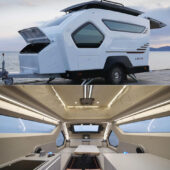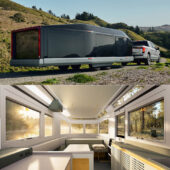

Magna Advanced Technologies decided in 2006 to develop something that would show that a Canadian supplier could build a vehicle from start to finish. The Torrero G2 Badlander, also called the HEMI Camper Trailer Concept, cost the company around $3 million. The goal was to create a single machine that could serve as a stylish daily driver, a light hauler, and the base for a complete camping setup.
Chuck Pelly and Jeff Teague worked on the concept. Pelly had extensive expertise working on race cars and was a big believer in real materials and practical features. Teague created a unified concept for the mix, bringing all of the different elements together. They began with a one-fifth scale clay model, then progressed to a full-size reproduction covered in handmade fiberglass panels and mounted on a modified 2005 Dodge Magnum RT chassis. The wheelbase was increased by two inches to improve balance and proportions.
Sale

LEGO Speed Champions Dodge Challenger SRT Hellcat Sports Car Toy - Building Set for Learning, Play and Display - Kids Toy for Boys and Girls, Ages 9+ - Birthday Gift Idea for Race Car Fans - 77237
- LEGENDARY MUSCLE CAR – Race fans ages 9+ can build the powerful LEGO Speed Champions Dodge Challenger SRT Hellcat, capturing the raw power of this iconic sports car
- AUTHENTIC DESIGN – This detailed toy car features the Hellcat's signature long hood, distinctive hood scoop, bold front grille, and dual tailpipes just like the real muscle car
- INCLUDES DRIVER MINIFIGURE – Set comes with a Dodge racing driver that children can place behind the wheel for exciting race scenarios on imaginary tracks and streets
$26.99
−$5.00
$21.99

Buy on Amazon
The finished design has delicate flowing lines that are not always parallel, as well as a gentle boat-like taper to the back. The front end features a big vertical grille, distinct fenders and running boards that blend perfectly into the profile, and a continuous character line that runs down the center of the body, clearly distinguishing the top and bottom components. There is not a single item on this thing that came from a catalog; practically every external and interior component, including the door knobs and sill plates, was custom-made.

Under the hood is a fully working 5.7-liter HEMI V8 engine with all-wheel drive and a one-of-a-kind Borla exhaust system. The prototype still drives well today, despite having only traveled roughly 300 miles, and behaves similarly to a regular production car from the time. It also features adjustable air suspension, which makes transporting much more convenient.
Now, the true genius of the design is demonstrated by how easily it can change roles; drop the mid-gate with a power window to let fresh air in or create an open load area, as the rear glass and trunk configurations can swap things around and transform the car into something closer to an El Camino pickup or simply a 4-door coupe. In the event that the weather improves, you can replace the removable glass roof panel with a cloth folding top.

The matching gooseneck trailer is attached using a proprietary electronic auto-hitch. The trailer transports the pin, which is held by a little jaw mechanism inside the car. You may lock or unlock the connection using the controls on the console without leaving the driver’s seat. Once mounted, it has its own electrical system, built-in parking brakes, and a self-leveling design with front and rear landing gear. Finally, when you unhook it, the trailer may be able to stand by itself.
A clam shell section on the trailer top serves as the foundation for a tent, transforming the entire structure into a full outdoor living space when another tent is added to the mix. You may then disconnect the vehicle and operate it as a separate driving or hauling vehicle; everything has been planned so that only one person is needed to oversee the transition from highway cruiser to camping, with no additional tools or support required along the way.

Inside, the crew approached it similarly, machining unique elements to replace typical manufacturing items in the cabin. Instead of cutting corners and reusing parts from the Dodge parts bin, this one-of-a-kind prototype had each surface and control developed uniquely. The end effect is a cohesive and meaningful interior that does not feel slapped together from a half-dozen different sources.
The concept was never taken beyond the single prototype stage because Chrysler decided it wasn’t worth pursuing at the time, and after the program ended, the car and trailer were sold separately during facility clearance. For the better part of a decade, they were stored, but in 2002, collector Robin James tracked down the car to an airport hangar and discovered the trailer, which was still nearby, allowing the two to be reunited.
[Source]