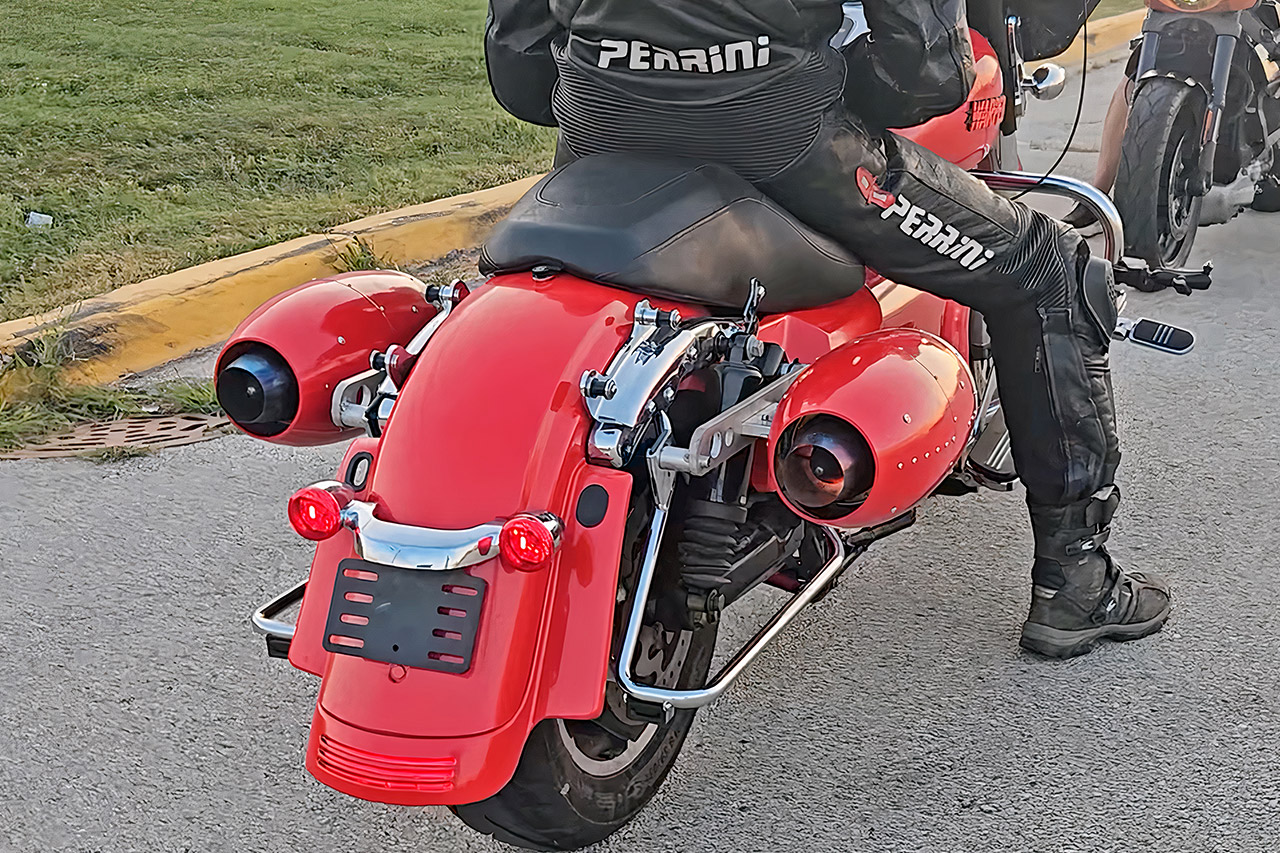
Sean Kerr of Bikes and Beards sent a thoroughly dead Harley-Davidson to Matt at Warped after the original V-twin failed beyond repair. Pistons sat exposed. Cylinder heads and walls were gone. Rather than rebuild the stock powerplant, Matt spent more than four hundred hours removing every trace of the conventional drivetrain and fitting a pair of micro-turbines in its place.
Those turbines sit to either side of the back wheel, each producing 70 to 75 pounds of thrust, for a total of one hundred fifty pounds. They run on diesel and are not linked to any mechanical parts. Twist the throttle, and the bike starts going forward without a transmission, gears, chain, or, luckily, a spinning crankshaft to give you the shakes. Kerr later described the sensation as simply being pushed forward by the air as the turbines began to spin up.
Sale

LEGO Technic Ducati Desmo450 MX Factory Motorcycle 42238 | Building Toys for Boys & Girls, Ages 10+, Dirt Bike Toy for Display W/ Stand, Bedroom or Desk Decor, 457 pieces, Gift Idea
- DUCATI MOTORCYCLE TOY – Unleash action-packed play for fans of high speed motocross with the LEGO Technic Ducati Desmo450 MX Factory Motorcycle (42238) building toy for boys and girls ages 10 years old and up
- PRETEND PLAY RACING ADVENTURES – Young builders can put their vehicle to the test by using the large handlebars to steer during epic high speed racing adventures
- PACKED WITH REALISTIC FEATURES – This motorcycle model kit comes with functional steering, a cylinder engine that’s driven by the chain from the rear axle, plus front and rear suspension
$49.99
−$5.00
$44.99

Buy on Amazon
When you remove the heavy engine and gearbox, it becomes noticeably lighter. Kerr estimated that the finished motorcycle weighed roughly three hundred and fifty pounds, but we shouldn’t be too concerned because this is all unofficial. On the street, the bike can easily reach sixty miles per hour and yet appears to have a little more to offer. To be honest, acceleration is all constant rather than a quick surge, mainly because the turbines take some time to build up pressure, but what’s a little strange is that you don’t feel any of that drivetrain lag that you’d normally get on a two-wheeled motorcycle.
In the meantime, safety was a concern because turbines can fail spectacularly, so each was outfitted with a containment and scatter shield. There is a manual fuel cutoff directly on the handlebars, but there is a long line between the valve and the engines themselves, and even then, the fuel continues to flow for a brief period of time after you flick the switch. Late in the build, a few components of hardware started to fail, prompting a bit of a rethink, but eventually, both turbines got lit and stayed operating long enough to have some legitimate road miles under their belt.
The factory Harley switchgear and displays remained in place. Custom electronics converted those old buttons and gages to operate with the turbines, allowing you to continue using all of your familiar components. There is a main six-gallon tank that feeds the engines, as well as a larger 11-gallon reserve tank for longer excursions. You can move fuel from one to the other without having to stop and swap containers.

The first thing most people notice about this bike is the noise, which sounds like a small jet poised to take off, rather than a nice calm ride at 60. The neighbors notice, and so does the rest of the traffic on the road – yet astonishingly, once you get it running, the bike remains as composed as you wish, with none of the normal mechanical clatter that comes with a traditional Harley. Kerr stated that the trip was unlike anything he had ever experienced on two wheels.

This project never aimed to replace your regular motorcycle. Its main objective was to address a single question: what happens when you abandon all traditional propulsion systems in favor of thrust? The answer is the bike sitting out there on the street, a bike that’s noisy, light, and can do sixty miles per hour with nothing but some air between the power source and the back wheel.
[Source]