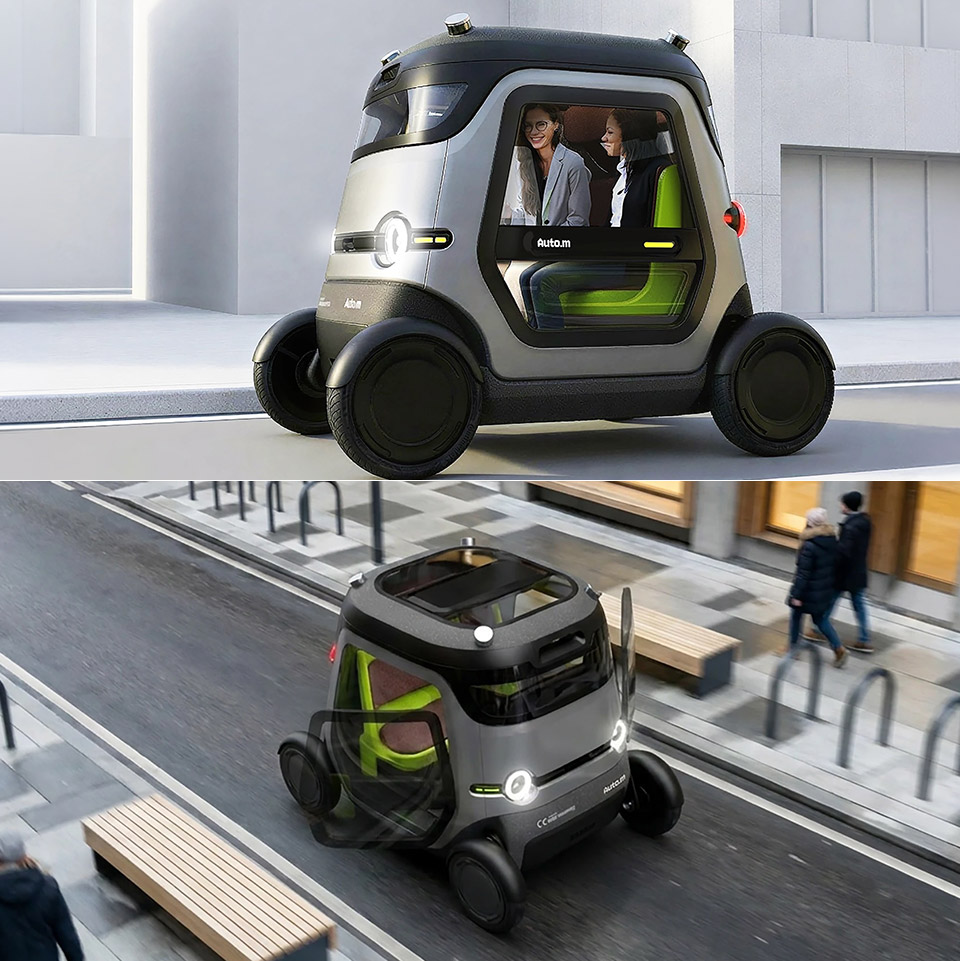
City streets keep filling with bigger machines that promise freedom yet eat more space every year. One designer decided the answer sits much closer to the ground and far smaller than the robotaxi fleets already rolling out. His name is Alejandro Otálora. From a San Francisco base he spent years shaping delivery robots, then turned that experience into a personal side project he simply calls Auto.m. The result looks like a friendly upright box that just won a 2026 Red Dot Award and might one day leave the render farm for real pavement.

Otálora first considered developing an autonomous cab in 2019. He preferred something that felt lovely and human-scale, rather than the massive pods that dominate the autonomous taxi discussion. He drew inspiration from iconic city automobiles such as the Fiat 500, Renault Twizy, and Citroën Ami, which demonstrate that people are willing to jam themselves into small electric vehicles when traffic becomes too congested. Auto.m uses the same small footprint but adds its own full set of self-driving brains, allowing the rider to never raise a finger.

- Extended Battery Life: Travel up to 43.5 miles on a single charge in ECO mode, ensuring long, uninterrupted rides with minimal recharging required.
- Effortless Control: Easy-to-use controls and intuitive handling make the scooter simple to operate, providing a smooth, stable, and enjoyable ride for beginners and experienced riders alike.
- Built for Durability: Constructed with high-quality materials designed to endure rough use and harsh conditions, the ZT3 Pro offers years of reliable service, providing durability that can withstand regular off-road adventures.

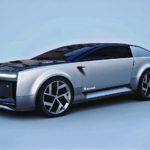
The Auto.m measures only 182.5 cm tall, 225.8 cm long, and 160.6 cm wide, making it shorter than many adults and narrower than a conventional parking space. Silver body panels wrap around a dark upper cabin with large side windows that can be kept frosted for further privacy. A narrow strip of clear glass lays across the front, allowing it to see what’s ahead, but the majority of the view remains private for those inside. Four small antenna poles emerge from the roof corners, equipped with LiDAR, radar, cameras, sonar, and GPS, allowing it to track every curb, bike, and pedestrian in real time.

The wheels are where the actual magic happens. Each wheel can change its location on the fly. So, at low speeds, the car can spin around in its own footprint like a doughnut, leaving no tire impressions, then straighten up and move forward again. That one approach allows Auto.m to park in places that ordinary automobiles cannot, particularly in tight European lanes that already pose a challenge for robotaxis. To keep it light and gentle on the environment, much of the body and some interior components are created from recycled plastics and rubber.

Inside, two people face each other across a brightly lit open floor. There is no typical dashboard, hence no steering wheel or pedals. Instead, you have a wonderful interactive digital surface where the AI assistant may talk to you, recommend stops, or simply let you relax and sleep. The cushions are a nice green color that encourages people to slide right in and forget they’re moving. Because all of the controls that used to be accessible to the driver have been removed, the cabin appears considerably larger than it is from the outside. You simply enter your ride request into an app, like you would with any other taxi, and the Auto.m arrives, unlocks the doors, and whisks you away to your destination as you scroll, rest, or chat with a buddy.

A 100% electric motor provides power, ensuring that the streets are quiet. The battery size and range are presently unknown because this is only a concept. Otálora designed it such that the numbers can increase as money comes in. Full Level 5 autonomy is critical to the concept, as the vehicle does everything from start to finish with no human intervention required. That puts it above systems that still require a safety driver or limited geofences. It can also roll in either direction if the path necessitates it, saving space during three-point revolutions.
[Source]