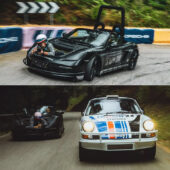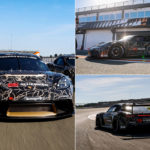
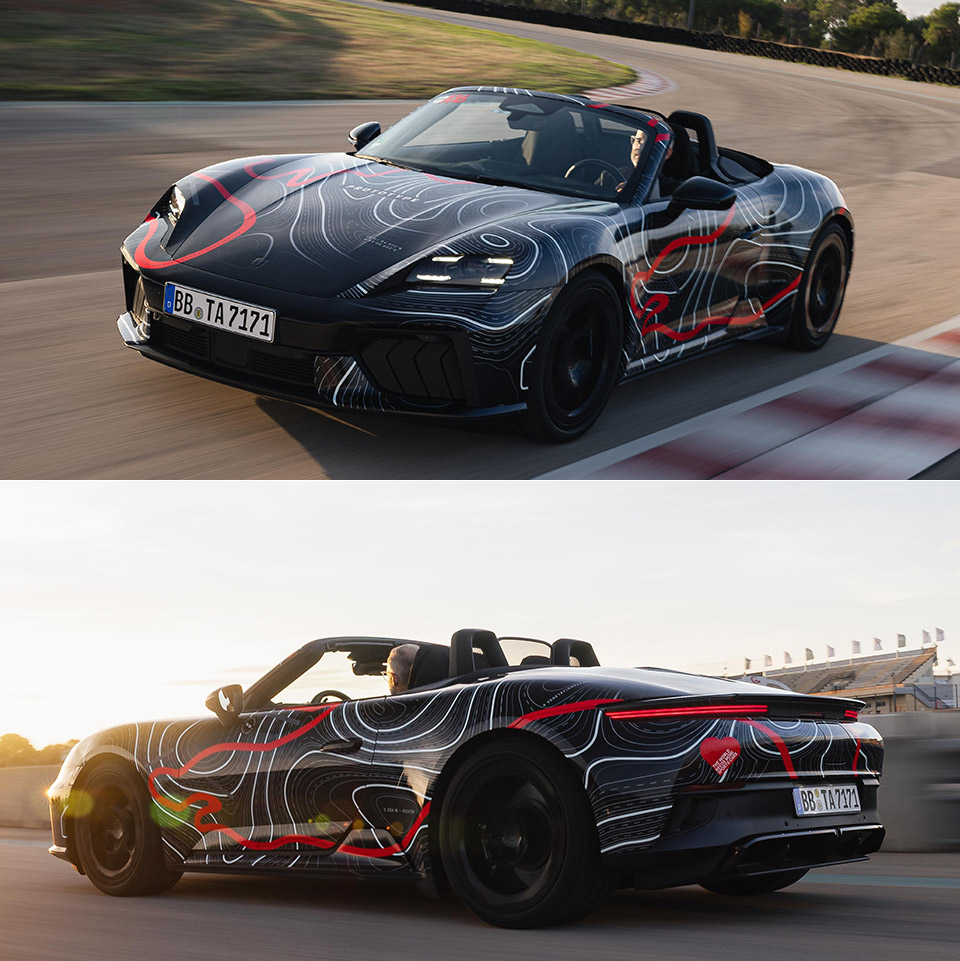
Porsche has pushed the first all-electric 718 Boxster into the final stretch of development. Prototypes have logged about four million kilometers across more than twenty countries, enduring -30°C ice in Sweden and 51°C heat in Death Valley. Engineers checked everyday usability in the dense traffic of Las Vegas, Los Angeles and Shanghai, tested charging under five different standards, and drove routes that ranged from 86 metres below sea level to 2,750 metres up. The production car is set for its world premiere in the first quarter of 2027 and will be built at the main plant in Stuttgart-Zuffenhausen.
The layout of the new Boxster is going to be an important decision. Instead of storing the power pack beneath the floor, Porsche has placed the 800-volt battery directly behind the seats in their new E-core Architecture, a clever trick they call it. By putting it back there, all of the weight is concentrated in the center of the car, resulting in a front-to-rear distribution of 40/60, which is comparable to a classic mid-engine sports car. As an added plus, it allows the automobile to maintain a low seating position, which most electric vehicles cannot achieve. Overall, the car’s weight is nearly equivalent to a modern 911 Cabriolet equipped with the T-hybrid system.

- BUILD A RACING LEGEND – Boys and girls ages 9 years old and up can construct the LEGO Speed Champions Porsche 911 GT3 RS Super Car (77239) building set and collect this iconic sports car model
- AUTHENTIC PORSCHE DETAILS – Young builders can recreate the real-life vehicle's signature elements including the famous rear wing, air intake features on the hood, distinctive headlights, and novelty rims
- 1 PORSCHE DRIVER MINIFIGURE – Kids can place the driver minifigure with helmet and red Porsche Track Day Experience outfit behind the wheel to stage their own track-day racing action

Chassis hardware comes directly from the 911 handbook. They’ve adopted the steering configuration from the Carrera GTS, rear-axle steering, which only recently debuted on a Boxster (so a bit of a novelty), and wheel and tyre sizes, as well as the braking system, are all identical to the 911. To ensure that everything runs smoothly, they’ve used the electronically controlled PTV+ limited slip differential, which is also used in the 911, to manage power to the rear wheels. As an interesting side note, all versions of the new Boxster will be rear-wheel drive.

Performance data already show that this is the fastest 718 to date. The top model can reach 100 km/h in less than three seconds and travel at speeds surpassing 250 km/h. It everything comes from a single back motor, albeit we don’t know the specific outputs or battery capacity just yet.

To keep the driver in the loop (so to speak), Porsche has decided to include E-shifting as standard in every single model. When you push a button, a simulated seven-speed PDK transmission appears, which you may operate automatically or manually using the paddles. The system has some versatility because it changes character depending on the driving mode you’ve chosen and provides you a little extra torque during each “shift” to ensure that the acceleration is consistent whether E-shift is turned on or off. And, as an extra benefit, when E-shift is engaged, the car will play a carefully replicated six-cylinder boxer sound from the 981 generation Boxster GTS through the speakers. When you turn it off, the identical paddles allow you to switch between three levels of energy recovery.

Not to be outdone, Walter Röhrl, one of the people who actually worked with the development program, stated that the result is the most input he’s received from any electric vehicle to date. Company executives would tell you that they never sought to just “go electric” on the Boxster, but rather to incorporate the Boxster’s personality into the new engine while also raising the performance ceiling slightly.