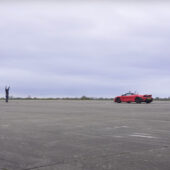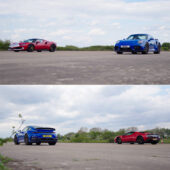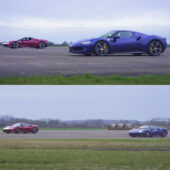
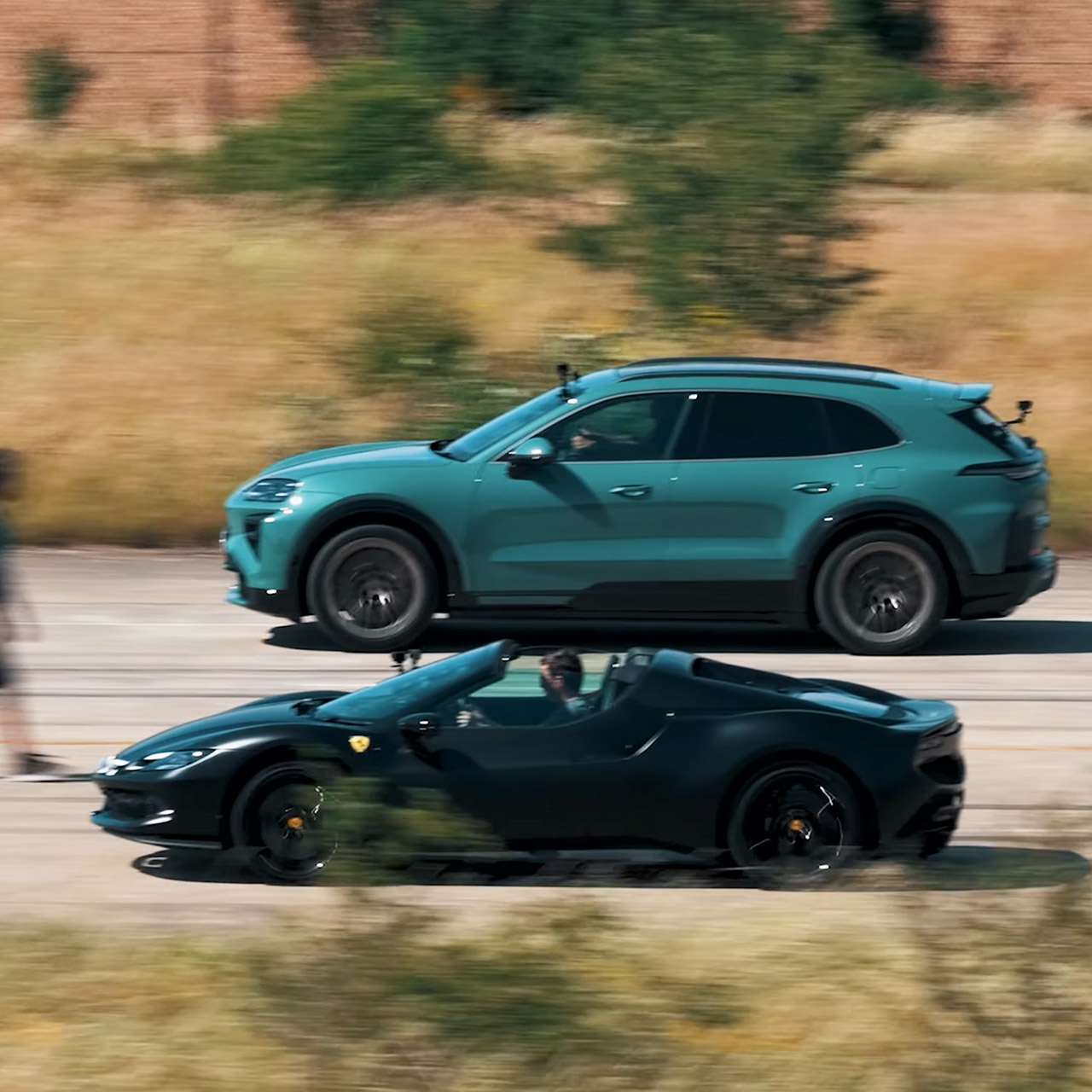
Mat Watson of CarWow lined up the heaviest Porsche ever built against a Ferrari 296 GTS to settle a simple question. Does massive electric power beat a lighter hybrid supercar when the lights go green?
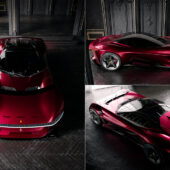
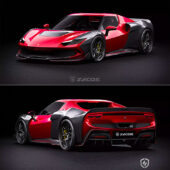
The Ferrari 296 GTS features a mid-mounted 3.0-liter twin-turbo V6 teamed with an electric motor, producing a combined 830 horsepower and 740 Nm of torque. An eight-speed dual-clutch transmission transmits power directly to the rear wheels. The curb weight might range between 1,540 and 1,640 kg, depending on who you ask. Ferrari claims a 0-60 mph time of only 2.4 seconds, a quarter mile time of around 9.8 seconds, and a top speed of 205 mph. In the UK, it will set you back nearly £280,000, while in the US, the beginning price is approaching $368,000 before you even consider adding a few features, which will likely push the price up to half a million.
Sale

LEGO Technic Ferrari FXX K Toy Car - Building Toy for Girls & Boys, Ages 10+ - Cool Birthday Gift for Kids - Race Car Model for Play & Display - 42212
- LEGO FERRARI MODEL CAR KIT – Builders ages 10+ can create the legendary Technic Ferrari FXX K with authentic details and working mechanical features
- AUTHENTIC RACE CAR DETAILS – This supercar building set features working butterfly doors, opening hood, and an engine cover that reveals the detailed V12 engine underneath
- CAR MODEL KIT – Young engineers explore real automotive concepts with this educational learning toy as they build the working differential and watch the car toy's realistic pistons move
$64.99
−$13.00
$51.99

Buy on Amazon

Next to it is the Porsche Cayenne Turbo Electric, which has two motors and produces 1,156 horsepower and 1,500 Nm of torque. Because of their all-wheel drive and smart launch control system, every ounce of torque is sent to the ground. The battery weighs roughly 600 kilograms and contributes significantly to the vehicle’s total weight of 2,645 kilos. According to official claims, the Ferrari and Porsche can go from 0 to 60 mph in 2.4 seconds and complete the quarter mile in 9.7 seconds, while the Porsche’s top speed is limited to 162. The pricing is far more reasonable, costing roughly £131,000 in the UK and $165,000 in the US.

On paper, the Ferrari appears to be a very strong performer, with a power-to-weight ratio of almost 539 horsepower per ton vs the Porsche’s 437. However, the numbers only reveal part of the tale. Mat had a spin in the Ferrari, while Yianni Charalambous drove the Cayenne. In standing starts, it was evident that the Porsche had instant torque and all-wheel drive traction on its side, as it just surged ahead and raced away from the Ferrari, which was trying to put its power down cleanly and spinning its rear tires. It was the same story on subsequent runs, as the Cayenne moved away from the Ferrari. The Porsche completed a quarter mile in 10.0 seconds, finishing 0.2 seconds ahead of the Ferrari. By the time it crossed the finish line, the Porsche had already surpassed 140 mph.

Things changed once he started rolling races. From 50 mph, the Ferrari’s reduced weight and strong mid-range pull allowed it to draw ahead and win the half-mile. A second run with both vehicles in their sportiest modes: Ferrari in Race and Porsche in Sport. In addition, Mat manually increased the ratios, resulting in another Ferrari triumph. Even when he did the roll at 10 mph, the Porsche still had a slight torque advantage, but the Ferrari reeled it in and passed. They also conducted a few braking tests, which revealed that the Porsche’s big gray cast-iron brakes, aided by regenerative systems, could stop the heavy Cayenne just a fraction of a second faster than the Ferrari’s carbon ceramic arrangement.