Photo credit: Car Design Trends
Mercedes-AMG continues its push into electrification across more of the lineup, yet one recent digital creation from outside company walls has stirred real conversation among those who still want a flagship model centered on an internal combustion engine. The Dark Star concept exists only as pixels, but its proportions and mechanical signals make a strong case for what a pure hypercar could deliver if the brand chose to keep fire at the core.

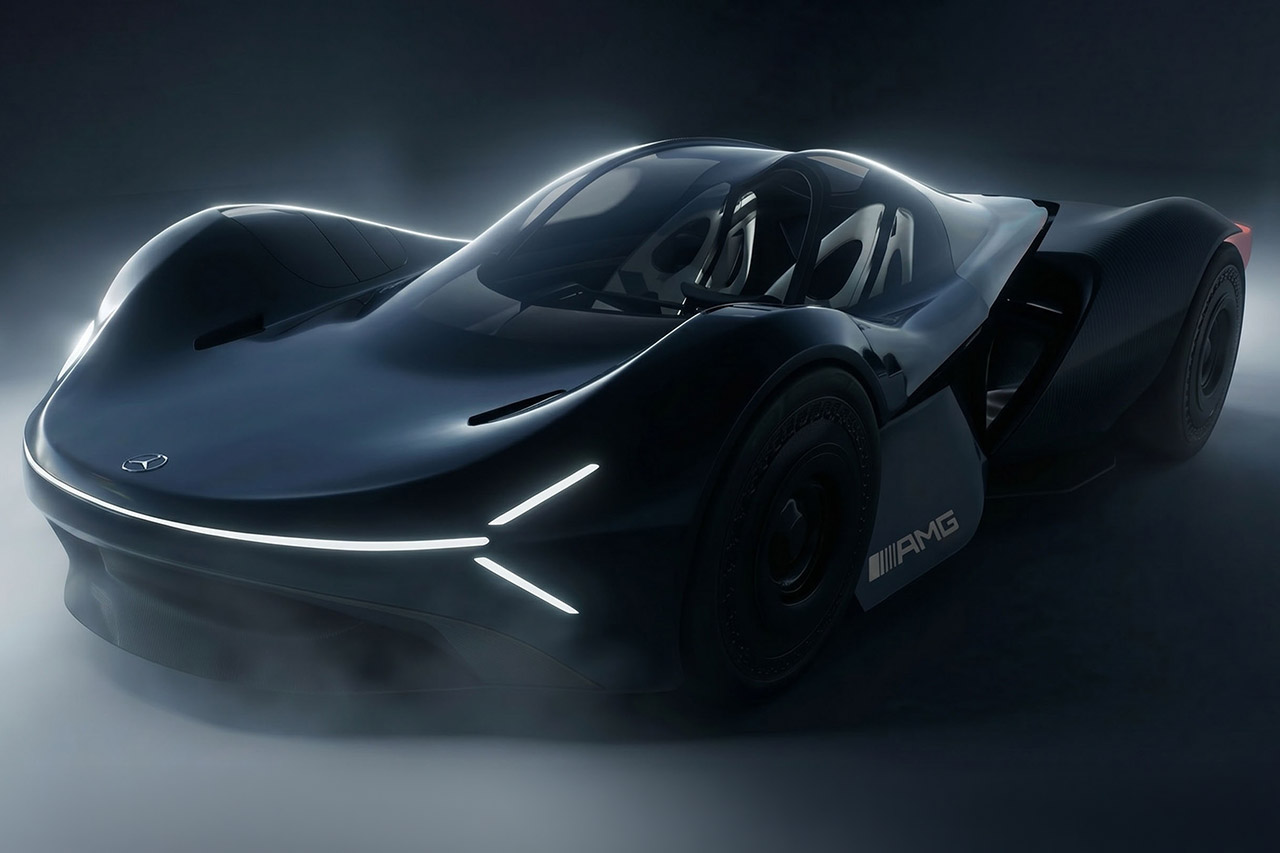
Tadeáš Čech, a transportation design student from Bratislava with previous experience at Volkswagen Design, produced the concept as a personal exploration. He distributed the piece via online automotive design forums, where it soon gained traction for its striking stance and focus on a classic powerplant. The overall design remains low, wide, and aggressive in a classic hypercar style. A two-tone split runs down the middle, with the front half finished in a deep, dark blue and the back section showing raw exposed carbon fiber. This contrast does more than just appear stunning. It emphasizes the lightweight construction theme that runs throughout the shape, with carbon fiber serving as the principal material both buried beneath paint and prominently displayed.

- 2 Mercedes toy cars for kids – LEGO Speed Champions Mercedes-AMG G 63 & Mercedes-AMG SL 63 vehicle playset for boys and girls ages 10 and up and adult model car collectors
- 2 driver minifigures – Each buildable vehicle toy comes with a driver minifigure wearing a Mercedes outfit so kids can role-play fast-paced races
- Authentic Mercedes design – Each collectible car model features design details from the real life versions, including front grilles, hoods, wheels, interior features and the famous Mercedes livery

The front treatment is kept reasonably clean while remaining extremely functional. A single full-width LED light bar rests high on the snout. Below it, a massive central intake dominates the lower fascia, resembling a broad mouth poised to swallow air. Slim whisker-style accents appear on either side, while dramatic fender flares rise steeply and have gill-style vents along their leading edges. The manta ray influence is clearly seen in the way the front corners rise and suggest motion even when the automobile is stationary.

The side profile keeps the body tight and contoured. Massive intakes on the flanks feed both the engine and the brakes. A spine-like grille feature runs down the middle section, while the back half tapers in a way that resembles the manta ray’s tail. The end product feels like forward motion caught in a single frame.
The exposed carbon fiber is continued over all surfaces with the rear treatment. Thin LED taillights integrate into aerodynamic parts, while a huge diffuser occupies the lower half. A third brake light in the style of F1 sits high in the center. The single enormous oval exhaust outlet, located dead center, leaves little doubt about the intended powertrain. This car was designed to breathe through an engine that still burns fuel and produces sound.

Cockpit treatment becomes minimalist and obsessive on weight. Very thin pillars provide for a wider vision while saving mass. The chairs take this idea even farther, appearing as hollowed-out shells designed to weigh nearly nothing. Instead of standard buckets, their design is more reminiscent of delicate eggshell. The entire interior feels naked, concentrated, and designed solely for the purpose of driving.
The render includes no horsepower statistics, top speed claims, or acceleration targets. Instead, the project serves as a clear statement. It investigates what Mercedes-AMG may still have to offer drivers who value the rapid response, high-revving nature, and sensory experience that only an internal combustion engine can provide in such an extreme car.
[Source]