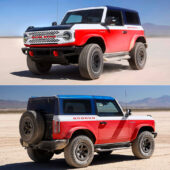

Ford designers marked the Bronco’s 60th anniversary by building a one-off concept that deliberately strips a modern two-door model back to its roots. They drew direct inspiration from a specific 1966 U13 Roadster owned by a friend of chief designer Robert Gilardi. That original served as both reference and reminder of what the Bronco represented at launch: an open, simple machine built for go-anywhere enjoyment rather than heavy equipment lists.
Back in 1966, Ford introduced the Roadster as the purest manifestation of their spanking new tiny 4×4, and let me tell you, it was the ultimate stripped-down version, with no doors or roof as standard. However, you can understand why production of this vehicle stayed limited, as there was simply no demand for it when the more practical wagon and half-cab models were available. It’s worth mentioning that only a few thousand of them were manufactured before the body form was discontinued after 1968. Years later, the survivors have become some of the most sought-after collectible early Broncos.
Sale

LEGO Technic Kids Toy Car - Building Kit for Boys and Girls, Ages 10+, Makes a Cool Birthday Gift, Authentic Ford Trim & Details - 42213
- FORD BRONCO MODEL CAR KIT – Builders ages 9+ can create their own off-road adventures with this detailed LEGO Technic SUV featuring authentic mechanics
- AUTHENTIC DETAILS – This car toy building set includes working suspension, opening doors, functional steering, and a detailed V6 engine under the lifting hood
- CAR MODEL KIT – Young engineers can explore learn more about their favorite vehicles with this building and learning toy that demonstrates real suspension systems and steering mechanics
$64.99
−$13.00
$51.99

Buy on Amazon
Ford’s updated take on the concept updates the original, raw idea with a modern touch. By methodically removing features, they were able to reduce the roadster to its fundamental requirements. They removed the doors and opened up the roof to allow for a beautiful, unobstructed flow of air, and to keep things simple, they chose to remove the rear seats and convert the back compartment into a small cargo bed with a full-size spare tire mounted on a Fifteen52 wheel, a great show stopper. The tailgate even folds down and features a traditional, stamped Ford logo. The new version retains the original’s plain steel bumpers front and rear, with no fancy frills or modern style in sight.

The body is painted Wimbledon White, with red accents running down the lower borders and back fenders, which is a nice touch. The seventeen-inch machined wheels pay respect to the original while retaining the period-correct stance of modern steel wheels, and the tires keep everything looking effortlessly cool. Inside, the seating is in low-back vinyl buckets, and yes, the headrests have been removed because, let’s face it, we love an open atmosphere. Oh, and all the belts are lap belts. To match the overall appearance of the originals, the dashboard and floor pan have been freshly painted in white. Some may argue that the central touchscreen and climate controls are unneeded, but for everyday use, they provide a nice touch to an otherwise very classic look. The cue-ball shift knob on the seven-speed manual is a nice touch.

Under the hood is the 2.3-liter turbocharged inline-four, which will be familiar to anyone who has followed the current Bronco series. It produces 300 horsepower and 325 lb-ft of torque. That power is supplied via the seven-speed manual transmission, which, by the way, has a special low crawler gear developed just for serious low-speed crawling. Behind all that power is modern 4-wheel drive hardware and improved brakes, allowing you to enjoy all the excitement of a classic Bronco without the weight and trouble of out-of-date brakes.

Jay Leno recently got the opportunity to test drive the new roadster on an episode of his Garage series, an excellent choice given his own fully customized 1968 Bronco. The contrast was stark, as he characterized it as actually joyful and peppy on the road around Los Angeles, particularly with the open layout and no shoulder belts to get in the way. The entire thing feels like a direct connection to the environment, which enclosed cabins rarely achieve.